Casino vs Cuban Salsa: What Makes Casino So Elegant?
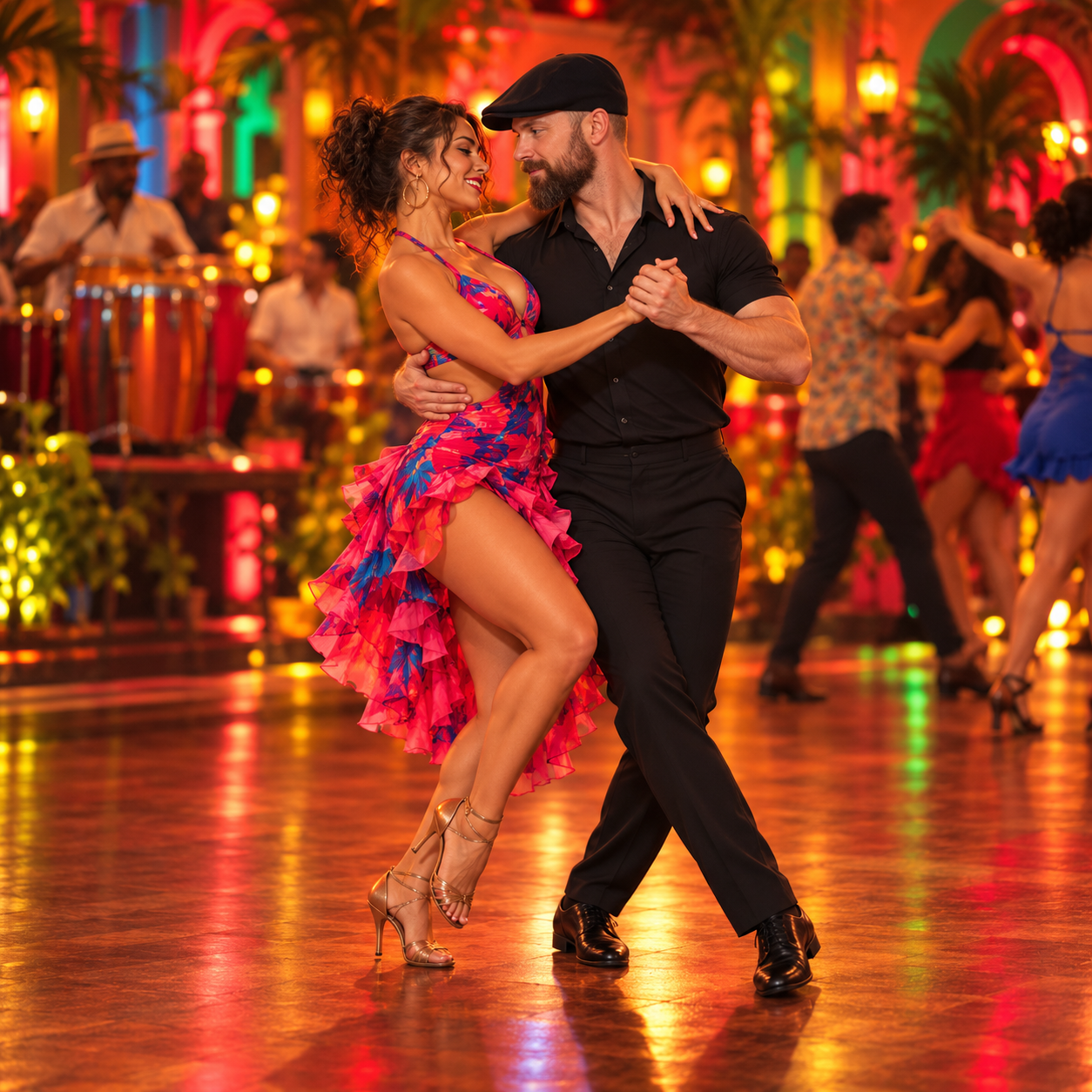
Casino vs Cuban Salsa – are they really the same dance?
Casino is a Cuban social partner dance that developed in the 1950s and grew from earlier Cuban dance traditions, particularly Son and cha-cha-chá. Outside Cuba, it is often described simply as “Cuban salsa”, but today Cuban salsa can also include influences and movements that go beyond traditional Casino.
For me, the most interesting difference is not the name. It is the way Casino works: natural walking, curved pathways, partner positioning, controlled changes of direction and connection between two continuously moving people.
And when those details come together, Casino can look almost effortless.
You do not simply see figures.
You see flow.

What Is Casino?
It was influenced by earlier Cuban dances, particularly Son and cha-cha-chá, and evolved socially as dancers exchanged ideas, adapted movements and created new possibilities.
Later, Casino also became the foundation of Rueda de Casino, where several couples dance together and respond to called movements.
Outside Cuba, however, another term became much more familiar:
Cuban salsa.
The two names are often used interchangeably.
And in everyday social dancing, I would not worry too much about correcting somebody simply because they say “Cuban salsa” rather than “Casino”.
But there is a useful distinction
Casino vs Cuban Salsa – Is There Really a Difference?
A Cuban salsa class may include Casino, but it can also incorporate:
rumba,
Afro-Cuban movement,
styling,
musical interpretation,
elements of timba,
and influences from other Cuban and international dance styles.
Casino is more specific.
When I use the word Casino, I mean the partner dance itself:
the relationship between two moving bodies, its characteristic pathways, changes of direction, positions, connection and the mechanics that allow one movement to naturally become another.
For me, the name is not the most important part.
Understanding why the movement works is.
You can call it Cuban salsa and dance beautifully.
You can call it Casino and still ignore many of its technical possibilities.
The interesting part begins when we ask:
Why does one dancer look smooth and effortless while another performs exactly the same figure but looks heavy, rushed or disconnected?
What Makes Cuban Casino Look So Elegant?
For me, elegance begins with efficiency.
Good Casino does not necessarily use less energy.
It uses energy more intelligently.
Movement created by one step can help generate the next.
A change of direction can use momentum that already exists instead of stopping the body and creating a completely new movement.
The feet do not need to hit the floor heavily.
The dancer does not need to run across large distances.
The body does not need to throw energy in every direction simply because the music becomes faster.
I sometimes describe the feeling to students as:
skating through the air
or
moving through clouds rather than landing heavily on the floor.
Another description I use is:
smooth like moving through butter.
The goal is not to remove personality or excitement.
The goal is to remove unnecessary effort.
Efficiency creates smoothness.
And when that efficiency becomes natural, you stop thinking about every technical detail.
Technique begins to disappear into the dance.
Casino Is a Conversation, Not a Monologue
One of the biggest changes in the way I began to understand Casino was recognising that both partners are constantly participating in the movement.
If the leader remains in one place while continuously sending the follower around using the arms, the conversation becomes one-sided.
Casino becomes much more interesting when both people move.
The leader changes position.
The follower changes position.
Space is continuously exchanged.
Imagine the follower travelling naturally towards familiar Casino positions such as dile que no, while the leader continually creates new options, changes pathways or moves into space that was previously available.
Then the relationship changes again.
And again.
I sometimes compare this interaction to yin and yang.
Two moving parts.
Two people continually balancing and adapting to one another.
The leader is not simply controlling another person from the centre.
The follower is not simply completing instructions.
Casino is a game of movement shared by two people.
Why Natural Walking Matters in Casino
Before talking about complicated combinations, we need to talk about something much simpler.
Walking.
It sounds almost too basic.
But many of the qualities people recognise as elegant Casino begin with the way the body travels.
When moving forwards, we encourage a natural stride.
The whole foot participates.
The heel can meet the floor naturally before the weight moves through the foot.
One leg lengthens while the other bends.
The stride remains controlled rather than becoming a run.
And importantly:
the body should generally face the direction in which it is travelling.
This sounds obvious.
But it changes a great deal.
If the feet travel sideways while the torso remains disconnected from the direction of movement, we can create what some dancers informally describe as “crab walking”.
The dancer still reaches the destination.
But the quality is different.
Natural walking supports posture, direction and a more organised relationship between both partners.
Forward Movement – an Old Idea Made More Deliberate
Forward stepping was not invented by MCC.
Casinero dancers were travelling forwards long before any modern methodology tried to analyse or systematise it.
The important difference is identification and repeatability.
A dancer may naturally step forwards in one movement because it happens to feel right.
Then use a large backward step in another.
Then change direction differently the following time.
That does not automatically make the movement wrong.
But once we identify why a particular movement works, we can practise it deliberately.
We can reproduce it.
We can analyse it.
We can refine it.
Eventually, it becomes part of our natural movement.
There is a famous idea widely associated with Bruce Lee: practising one technique thousands of times may be more valuable than practising thousands of techniques only once.
That principle fits Casino beautifully.
Knowing fifty figures does not automatically create a great dancer.
Understanding one fundamental action deeply enough to reproduce it comfortably and consistently can be much more valuable.
Repetition creates consistency.
And consistency gives us the opportunity to refine details.
Does Casino Mean Never Stepping Backwards?
No.
This distinction is important.
A backward step is not automatically a mistake.
The real question is:
What does the backward step do to the relationship between the two partners?
If a dancer moves backwards while maintaining posture, connection and appropriate distance from the partner, the movement may work perfectly well.
But a large backward step can create several problems.
The leg may be thrown behind the body.
Posture may break.
Distance increases.
Arms straighten.
And eventually somebody has to pull the other person back.
This creates what I often call the rubber-band effect.
The partners repeatedly stretch away from one another and then recover that distance through the arms.
It can still work socially.
It can still be enjoyable.
But it creates a different quality of movement.
There is another important consequence.
When the leg is thrown significantly backwards and the body loses its organisation, certain following movements become more difficult.
Some options can disappear because the body is no longer positioned efficiently enough to access them.
Avoiding unnecessary backward movement therefore does more than change appearance.
It can open more possibilities.
This is why details matter.
“Never step backwards” would be too simplistic.
A better question is:
Can I make this movement without unnecessarily breaking posture, distance and momentum?
Why Casino Uses Curved Pathways
Casino is not simply a dance of straight lines.
Curved pathways are an important part of how partners travel.
An exercise I use with beginners is to imagine a clock face.
When dancing a tiempo, three steps can travel along part of a curved pathway.
Around the pause, the body can reorganise and change direction before continuing along another pathway.
For example, we may practise movement approximately between the 4 o'clock and 8 o'clock positions, reversing direction while preserving natural stride and posture.
The clock itself is only a teaching tool.
The more important principle is:
Casino is not simply dancing around your partner. It is two people travelling together through organised pathways.
Once the pathway becomes clear, many figures stop feeling like unrelated sequences.
They begin to look like variations of the same movement principles.
Connection Is Much More Than Hands
Students often think partner connection exists mainly in the hands.
Hands certainly matter.
Palm placement can influence the quality of communication.
But connection continues through the entire body:
wrist,
elbow,
shoulder,
torso,
posture,
direction of travel,
weight transfer,
and finally the position of the feet.
Two bodies positioned efficiently can communicate with surprisingly little force.
The leader does not need to drag the follower.
The follower does not need to guess.
Body position already communicates a great deal.
This also helps explain why different types of leading exist.
When both partners travel in a compatible direction, body movement itself can communicate strongly.
When pathways cross or partners move differently, the arms may play a greater role.
Understanding that difference is much more useful than simply memorising:
“put your hand here, pull there and your partner will go over there.”
Elegant Turning Is Not Simply Spinning
Different dances use different turning mechanics.
Sometimes the centre of the body acts as the main axis.
Sometimes a shoulder becomes an important reference while the body moves around it.
Casino contains walking turns as well as movements that rotate much closer to the spot.
The visual result may look simple.
The mechanics underneath it are not always simple.
Understanding how a turn is created can make it smoother, safer and easier to repeat.
Instead of turning first and trying to recover balance afterwards, we can investigate:
where the axis is,
where the body is travelling,
how momentum is being used,
and what information the partner is providing.
Sometimes a very small technical adjustment completely transforms the appearance of the movement.
Who Is Yoel Marrero Cabadilla?
One of the strongest influences on the technical approach we explore is Yoel Marrero Cabadilla, developer of the Método del Cuadro del Casino – MCC.

Yoel's background is unusual for somebody recognised primarily through dance.
He trained in chemistry, worked in research and taught at university level before applying a highly analytical way of thinking to Casino.
That analytical background is easy to recognise in MCC.
Instead of seeing Casino as an endless collection of figures, the approach examines recurring structures:
positions,
pathways,
changes of direction,
body relationships,
recurring routines,
and the way more complex combinations grow from simpler foundations.
MCC did not create Casino.
Casino existed decades before MCC.
Excellent Casino dancers existed before MCC.
Forward movement existed before MCC.
Curved pathways existed before MCC.
What MCC provides is a framework for identifying, analysing, practising and reproducing characteristics of Casino more deliberately.
That is where I find its real value.
MCC is a structured approach to analysing Casino.
Rather than teaching only a catalogue of figures, it helps organise movement into recurring positions and pathways.
This creates a different way of learning.
Instead of thinking:
“What is the next figure?”
we can begin thinking:
“Where are we now, where can we travel from here and what movement logically connects those positions?”
This is important because a long combination is often not a completely new object.
It may simply be a sequence of familiar foundations organised in a different way.
MCC gives students a language for recognising those relationships.
It does not need to remove creativity.
Quite often, understanding the structure creates more freedom to improvise.
What Is Casino Bien Formado?
The term Casino Bien Formado can roughly be understood as “well-formed Casino”.
For me, it represents one of the strongest technical models available for studying efficient Casino movement.
But this does not mean it is the only valid way to dance Casino.
And it certainly does not mean every dancer should look identical.
Quite the opposite.
A strong technical foundation should allow individuality to become clearer.
Two dancers can perform exactly the same movement.
One may use softer expression.
Another may emphasise rhythm differently.
One may have a stronger personality.
Another may appear more understated.
The step itself has not necessarily become more difficult.
What changes is the quality and character of execution.
This is where individuality becomes style.
I therefore do not see Casino Bien Formado as a method designed to remove personality.
I see it as a way of giving personality a technically sound foundation.
Efficiency creates smoothness.
Repetition creates consistency.
Individuality creates style.
Is Casino Bien Formado the “Best” Casino?
I would be careful with that statement.
Casino is a living social dance.
It has always contained personal interpretation.
It can be danced in a beautiful dance studio, at a party, outside, in a park or on the street.
Different environments naturally create different qualities.
A dancer moving on a rough outdoor surface may move differently from somebody dancing on a wooden studio floor.
And that is completely normal.
But when we have good conditions, good information and access to detailed technical knowledge, why would we not use them?
There is value in experiencing the roots and understanding how Casino has been danced socially.
There is also value in refinement.
For me, Casino Bien Formado is one of the strongest models for learning and analysing Casino, even though it may not always be the simplest approach for a complete beginner.
The framework provides structure.
The individual provides personality.
The strongest dancing often appears when those two things meet.
Does Technique Limit Creativity?
This is one of the biggest misunderstandings around structured teaching.
Rules can sound restrictive.
Positions can sound restrictive.
Pathways can sound restrictive.
But the opposite can happen.
If you only know memorised sequences, your creativity depends on remembering the next sequence.
If something unexpected happens, the pattern may disappear.
But if you understand:
where you are,
where your partner is,
which pathways are available,
which direction your momentum is already taking you,
and which movements can logically grow from that position,
you suddenly have more options.
Structure can create freedom.
MCC interests me not because I want every dance to look identical.
It interests me because understanding structure makes improvisation easier.
Instead of asking:
“Which figure comes next?”
you begin asking:
“What options do I have from here?”
That is a very different way of dancing.
10 Principles That Influence Our Casino Teaching
The following principles summarise an interpretation of a Casino teachers who studied with Yoel Marrero Cabadilla.
Their approach is strongly influenced by Yoel's work.
These principles should not be treated as ten historical laws deciding who is or is not allowed to call their dancing Casino.
I prefer to treat them as technical tools.
They help us ask better questions about movement.
1. Keep moving forwards
Avoid unnecessary backward steps that significantly increase the distance between partners.
Backward movement can work perfectly well when distance, posture and connection remain organised.
The important question is not simply:
“forward or backward?”
It is:
what does the movement do to the partnership?
2. Change direction around counts 4 and 8
When dancing a tiempo, three travelling steps create movement.
The pause provides an opportunity to redirect the existing momentum.
A tap or another technical adjustment may help prepare the next direction.
3. Walk naturally
Use a comfortable stride.
Allow one knee to lengthen while the other bends.
Use the whole foot rather than remaining permanently on the toes, heels or in a crouched position.
4. Match the lead to the direction of travel
When both partners travel together, body position can provide much of the information.
When pathways cross or partners travel differently, the arms may play a stronger communicative role.
5. Keep the elbows pointing down
Avoid unnecessarily raising the elbows above the hands.
This helps preserve a more natural and comfortable structure.
6. Follow your elbow
The elbow of the connected arm should remain organised in relation to the body rather than being left behind while the torso moves away.
The body follows the movement rather than abandoning the arm.
7. Maintain a comfortable bend in the elbows
Completely straight arms increase distance between partners.
They can restrict natural body movement and create unnecessary tension.
8. Maintain consistent distance between partners
Both dancers should contribute to preserving comfortable spacing.
The goal is to travel without constantly stretching apart and recovering through the arms.
9. Move along curved pathways
Casino frequently uses arcs.
Even movements that initially appear straight can contain curved travelling patterns.
Understanding these pathways can create smoother transitions.
10. Prioritise elegance and your partner's comfort
Social dancing should feel good for both people.
Complicated-looking arm patterns, repeated turns or long combinations are never more valuable than comfortable, controlled foundations.
Your partner is not equipment used to complete a figure.
They are the other half of the conversation.
Are Complicated Casino Figures Really More Advanced?
Students naturally assume progression works like this:
basic figure → complicated figure → very complicated figure → advanced dancer
I do not think Casino works that way.
Many long combinations are simply repetitions and variations of familiar foundations:
positions,
pathways,
direction changes,
turns,
partner exchanges,
and different hand arrangements.
The combination becomes longer.
The arms may appear more complicated.
But the fundamentals remain.
That leads to one of the most important ideas in my teaching:
Advanced Casino is not necessarily about doing more. It is about doing simple things exceptionally well.
A dancer performing a basic movement with control, connection, timing and effortless transitions may look considerably more advanced than someone performing a long sequence while fighting against posture, balance and partner comfort.
The figure does not make the dancer advanced.
Execution does.
Why Beginners Sometimes Learn Faster by Skipping Details
Different teachers have different priorities.
Some methods aim to get beginners socially dancing as quickly as possible.
And there is nothing wrong with that.
A student may hear:
“Step here.”
“Move there.”
“Bring your partner to the other side.”
“Turn now.”
Very quickly, the student can complete something recognisable as a dance.
That creates confidence.
It creates enjoyment.
But detailed mechanics may be postponed.
Another approach may initially feel slower.
It asks:
Why are you stepping there?
Where is your weight?
Which direction are you facing?
Has your distance changed?
Why did the turn work?
What created the lead?
This approach can require more attention at the beginning.
But the movement habits it creates may be easier to reproduce later.
Neither approach removes the joy of dancing.
They simply prioritise different things.
At Salsa Banbury, I want students to have fun and understand enough of the mechanics to develop strong habits.
Complete beginners can also start with our Salsa Jump Start experience in Banbury.
My Experience with LA-Style Salsa, Cuban Salsa and Casino
This section is only my personal observation.
I do not present myself as an advanced LA-style salsa specialist, so I would never try to define an entire style for dancers who have spent their lives studying it.
I taught LA-style salsa and Cuban salsa for many years before focusing much more closely on Casino.
From my own experience, LA-style salsa often felt more linear.
Movement appeared to happen along a clearer pathway.
Spins, visual presentation and choreographic expression seemed to play a stronger role.
Cuban salsa felt much freer.
There was more opportunity to move around each other, change direction and simply enjoy the energy.
That freedom is incredibly enjoyable socially.
But freedom can sometimes hide technical shortcuts.
If something is slightly untidy, energy and continuous movement can make it less obvious.
You simply keep dancing.
And there is absolutely nothing wrong with enjoying the dance that way.
Sometimes the whole point is to stop analysing and allow music and emotion to take over.
Casino changed something for me because I began to understand why particular movements worked.
The arcs.
The changes of direction.
The distance.
The difference between body leading and arm leading.
The way momentum could be reused.
And how efficiency could create elegance.
That is the important distinction for me.
Emotion and technique are not opposites.
The goal is not to spend the entire dance consciously analysing every heel, elbow and pathway.
We practise details so eventually we do not need to think about them.
When technique becomes automatic, we can give ourselves to the music while the body continues to move efficiently underneath.
That is when something special happens.
Casino, Cuban Salsa and Timba
Modern Cuban dance culture continues to evolve.
Music changes.
Fashion changes.
Dance spaces change.
People travel and exchange ideas faster than previous generations ever could.
Modern timba can encourage a very different energy from older, more Son-influenced music.
It can be faster, more explosive and rhythmically intense.
That naturally affects the way people move.
I do not claim to be a musicologist, so I would not try to define the entire evolution of Cuban music.
But as a dancer, I notice a difference in energy and speed.
The faster and more explosive the movement becomes, the more physical force we create.
That can be exciting.
But it can also create more uncontrolled movement when technique does not support it.
Casino therefore continues to change.
Different influences mix.
Individual dancers add personality.
Teachers interpret the work of previous teachers.
Elements from other dances naturally appear.
For me, this does not mean Casino should be frozen in time.
It means understanding its foundations becomes even more valuable.
What Does Authentic Casino Mean?
This is a difficult question.
I am not Cuban.
I would therefore be uncomfortable declaring what is or is not “authentically Cuban” on behalf of people who grew up within that culture.
For me, authenticity begins with respecting the people, traditions and movement characteristics through which Casino developed.
It also means learning from people who have studied those traditions directly.
But Casino has never stopped evolving.
Authenticity should therefore not become an excuse to reject every new idea.
The challenge is finding a balance:
understand where something came from before deciding how you want to evolve it.
That is the approach I prefer.
What If I Do Not Want Rules – I Just Want to Dance?
Perfect.
That is ultimately the goal.
Dance.
Enjoy the music.
Laugh with your partner.
Improvise.
Stop analysing.
But learning technique does not mean consciously thinking forever.
We study the rules so eventually we no longer need to think about them.
A musician practises scales.
A boxer practises fundamental punches.
A footballer practises passing.
They do not do this because every performance should feel like an exercise.
They practise fundamentals so those fundamentals become automatic when performance begins.
Casino is no different.
The Elegance of Casino Is Not Hidden Inside Complicated Figures
For me, this is the biggest message.
If you want to become a better Casino dancer, do not only ask:
“What new figure can I learn?”
Ask:
Can I make my basic movement smoother?
Can I change direction without breaking momentum?
Can I maintain distance without pulling?
Can I lead with less effort?
Can I turn without losing posture?
Can I make my partner feel comfortable?
Can I perform something simple so beautifully that somebody watching wants to understand how I did it?
That is a different definition of progression.
And personally, I find it much more interesting.
Casino Bien Formado Is a Foundation, Not a Cage
This is perhaps the simplest way I can summarise my current view.
MCC is not a set of laws defining who is or is not dancing Casino.
It is a framework that helps us analyse why certain movements can feel more efficient, connected and elegant.
Casino existed before MCC.
Great Casino dancers existed before MCC.
What MCC provides is a language and structure for studying qualities that previously may have been learned largely through observation, repetition and experience.
And Casino Bien Formado does not need to remove individuality.
It can give individuality something stronger to grow from.
Learn the structure.
Practise the structure.
Make it natural.
Then make it yours.
Frequently Asked Questions About Casino and Cuban Salsa
Is Casino the same as Cuban salsa?
The terms are often used interchangeably, especially outside Cuba. However, Cuban salsa has become a broader international label, while Casino refers more specifically to the Cuban partner dance and its characteristic movement, pathways and partner interaction.
What is MCC in Cuban Casino?
MCC stands for Método del Cuadro del Casino. It is a structured approach developed by Yoel Marrero Cabadilla to analyse positions, pathways and recurring movement structures within Casino.
Did MCC create Casino?
No. Casino existed decades before MCC. MCC provides a framework for studying and teaching characteristics of an already existing dance.
What is Casino Bien Formado?
Casino Bien Formado is associated with Yoel Marrero Cabadilla's formalised approach to Casino. I see it as a strong technical model for studying efficient, organised and elegant Casino movement.
Does Casino mean you should never step backwards?
No. A backward step can work perfectly well when it preserves posture, connection and partner distance. Problems appear when the step unnecessarily increases distance, breaks posture or creates a strong rubber-band effect.
Why does good Casino look so smooth?
Smooth Casino often comes from efficient movement: natural walking, controlled partner distance, curved pathways, use of momentum and clear changes of direction.
Learn Cuban Casino in Banbury
At Salsa Banbury, we do not want students simply to memorise longer and longer combinations.
We want you to understand the movement underneath them.
Our Casino teaching explores:
natural walking,
curved pathways,
changes of direction,
partner positioning,
connection,
body and arm leading,
turning technique,
comfortable partner distance,
and smoother transitions.
Whether you are completely new to Cuban salsa or have already been dancing for several years, these details can completely change the way your dancing feels.
Ready to Experience the Difference?
Understanding Casino on paper is useful.
Feeling the difference in your own movement is something else entirely.
Join our Sunday Casino classes in Banbury to explore the details that create smoother, more comfortable and more elegant partner dancing.
For dancers who would like more individual attention, 1-to-1 Casino tuition allows us to analyse movement in much greater detail.
Sometimes one small technical adjustment can transform an entire movement.
And once you begin to understand the difference, you may never look at a “simple” Casino figure in quite the same way again.
Frequently Asked Questions About Casino and Cuban Salsa
Is Casino the same as Cuban salsa?
The two terms are often used interchangeably, especially outside Cuba, but they are not always used to describe exactly the same thing. Casino refers more specifically to the Cuban partner dance and its characteristic movement, pathways, partner positions and changes of direction.
Today, the term Cuban salsa is often used more broadly and may also include styling, rumba, Afro-Cuban movement, timba interpretation and influences from other dance forms.
What is MCC in Cuban Casino?
MCC stands for Método del Cuadro del Casino, a structured approach developed by Yoel Marrero Cabadilla for analysing Casino movement.
Rather than treating Casino simply as a collection of figures, MCC helps dancers understand recurring positions, pathways, direction changes and movement structures.
For me, its greatest value is that it turns something we may previously have copied by observation into something we can analyse, practise and reproduce more consistently.
Did MCC create Casino?
No.
Casino existed decades before MCC, and excellent Casino dancers existed long before the method was developed.
MCC provides a framework for studying and explaining characteristics already present within Casino. It helps dancers understand why certain movements work and how they can be practised more deliberately.
What is Casino Bien Formado?
Casino Bien Formado can roughly be understood as “well-formed Casino.”
I see it as one of the strongest technical models for studying efficient, organised and elegant Casino movement.
It is not about making every dancer look identical. A strong technical foundation should still leave room for musicality, personality and individual style.
Technique provides the foundation. The dancer provides the character.
Does Casino mean you should never step backwards?
No. A backward step is not automatically wrong.
The important question is what that step does to posture, momentum and the distance between partners.
If a backward movement preserves connection and comfortable spacing, it may work perfectly well. Problems appear when a large backward step moves the partners unnecessarily apart, straightens the arms, breaks posture or creates a strong rubber-band effect.
The aim is therefore not simply “never step backwards”, but to understand why you are stepping and what options that movement creates or removes.
Why does good Casino look so smooth?
Smooth Casino usually comes from many small details working together.
Natural walking, curved pathways, controlled partner distance, efficient use of momentum, clear changes of direction and comfortable connection all contribute to the final result.
The dancer is not necessarily using less energy.
They are using energy more efficiently.
Are complicated Casino figures more advanced?
Not necessarily.
Many complicated-looking combinations are built from exactly the same foundations as simpler figures: familiar positions, pathways, turns, changes of direction and variations in hand placement.
The real difference is often the quality of execution.
Advanced Casino is not necessarily about doing more. It is about doing simple things exceptionally well.
Learn Cuban Casino in Banbury
Understanding Casino intellectually is useful.
Feeling the difference in your own movement is something completely different.
At Salsa Banbury, our Casino classes focus not only on learning figures, but on understanding the details underneath them: natural walking, curved pathways, partner positioning, connection, turning mechanics, changes of direction and efficient movement.
Whether you are completely new to Cuban salsa or have already been dancing for several years, small technical adjustments can completely change the way your dancing feels.
Ready to Feel the Difference?
Join our Sunday Casino classes in Banbury to explore these principles in a relaxed social environment.
If you would like more detailed individual feedback, 1-to-1 Casino tuition gives us the opportunity to analyse your movement, connection and technique much more closely.
Sometimes one small adjustment is enough to transform a movement you have been performing for years.
Learn the structure. Practise the structure. Make it natural. Then make it yours.
About the Author
Michael Zaskorski has been teaching salsa in Banbury for over eight years, with experience in LA-style salsa and Cuban salsa. Over the past year, his teaching has focused increasingly on Cuban Casino, with particular attention to the technical details that create smoothness, efficiency, partner comfort and elegance of movement.
His current teaching is influenced by Casino, MCC and Casino Bien Formado, while still drawing on his wider experience of different salsa styles.
Comments